
Chip tuning or Powerbox?
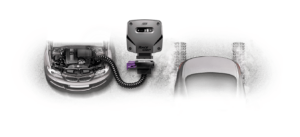
If you’ve already decided to modify your automobile to improve its power and torque, you’re confronted with the choice of installing a new program in the engine control unit (a.k.a. popular chip tuning) or using an external digital controller connected to the car’s wire harness (i.e. tuning box or powerbox).
Each option has its own set of benefits and drawbacks, and while our company produces both tuning programs and powertrains for diesel and gasoline vehicles, we’ll try to discuss each one as objectively as possible below.
Chip tuning is the process of reprogramming the ECU.
The change entails altering the ECU’s setpoints (maps) (Engine Control Unit). If the driver does not allow for this option, it can be done by disassembling and opening the control unit, then connecting to it from the inside and reprogramming the memory. The end result is the same in both cases: fresh maps change the engine’s performance and settings.
Chip tuning modifies the following basic parameters: turbocharger boost pressure (if present; chip tuning is also feasible in non-turbocharged vehicles); fuel dose and/or fuel injection pressure; injection angle (diesel); and ignition timing (petrol). Although more subtle alterations are conceivable, the vast bulk of the power increase is determined by these three basic parameters (fuel dose, boost pressure, and ignition timing).
Chip tuning has the following advantages: no additional equipment; the ability to influence all three primary performance metrics; the ability to make further modifications, such as adjusting the idle speed, start-up dosing, turning off the DPF or FAP, or changing the speed and turnover limiters.
The disadvantages of chip tuning include the risk of losing free manufacturer support due to amateurishly performed tuning, especially if the manufacturer’s authorised service detects the change, there are interferences in the car’s performance, and the chip has not been properly written and customized for the car. There is no way to quickly “remove” the chip and return the vehicle to its pre-delivery condition. The alteration will also be removed and the automobile restored to its delivery condition after updating the driver software, which is done on a regular basis while repairing the car. Finally, existing chip tuning cannot be installed in another automobile, even if it is of the same make and engine.
The external tuning controller, Powerbox
The change consists of modifying the values read by the car’s sensors so that the engine control unit corrects boost pressure and fuel dose (or only pressure and, indirectly owing to this, dose). The powerbox then modifies two fundamental factors (chip tuning – three). An indirect method of changing parameters is sometimes referred to as “tampering with the measures” and presented as proof of chip tuning’s superiority over the powerbox, but from a programming standpoint, whether the new parameters are entered directly into a map or obtained in an indirect manner is irrelevant for achieving the final effect, as long as they are well programmed. The powerbox, like the chip, has its own map corrections for the two parameters given above, which it applies based on the engine load and speed. It is impossible to tell whether a car has a powertrain or a chip while driving, yet a well-executed chip tuning will provide stronger effects (slightly higher power and torque) due to the alteration of one extra factor and increased opportunities to impact fuel quantity.
The benefits of the powerbox include the ability to turn it on and off remotely (using a remote control or an Android or iOS device), as well as the ability to reinstall it in another vehicle, even one of a different make (though you may need to change the wire harness for one fitting another make and change the tuning map in the powerbox system). The tuning box can also be removed from the automobile before it is serviced by the manufacturer; this is simple due to the wire harness of a powerbox having original plugs that can be readily plugged in and out.
The powerbox has two disadvantages: it can only change two of the three key parameters (boost pressure and fuel amount), and it can’t change the injection / ignition angle.
Furthermore, because to constraints in automobile construction, it cannot have the same impact on fuel quantity as chip tuning.
As a result, the performance boost achieved with the powerbox will be less than that achieved after chip tuning. However, chip tweaking a certain model is often impossible or impractical, and the only option is to use a powerbox.